The Miracle of the Unspent Body
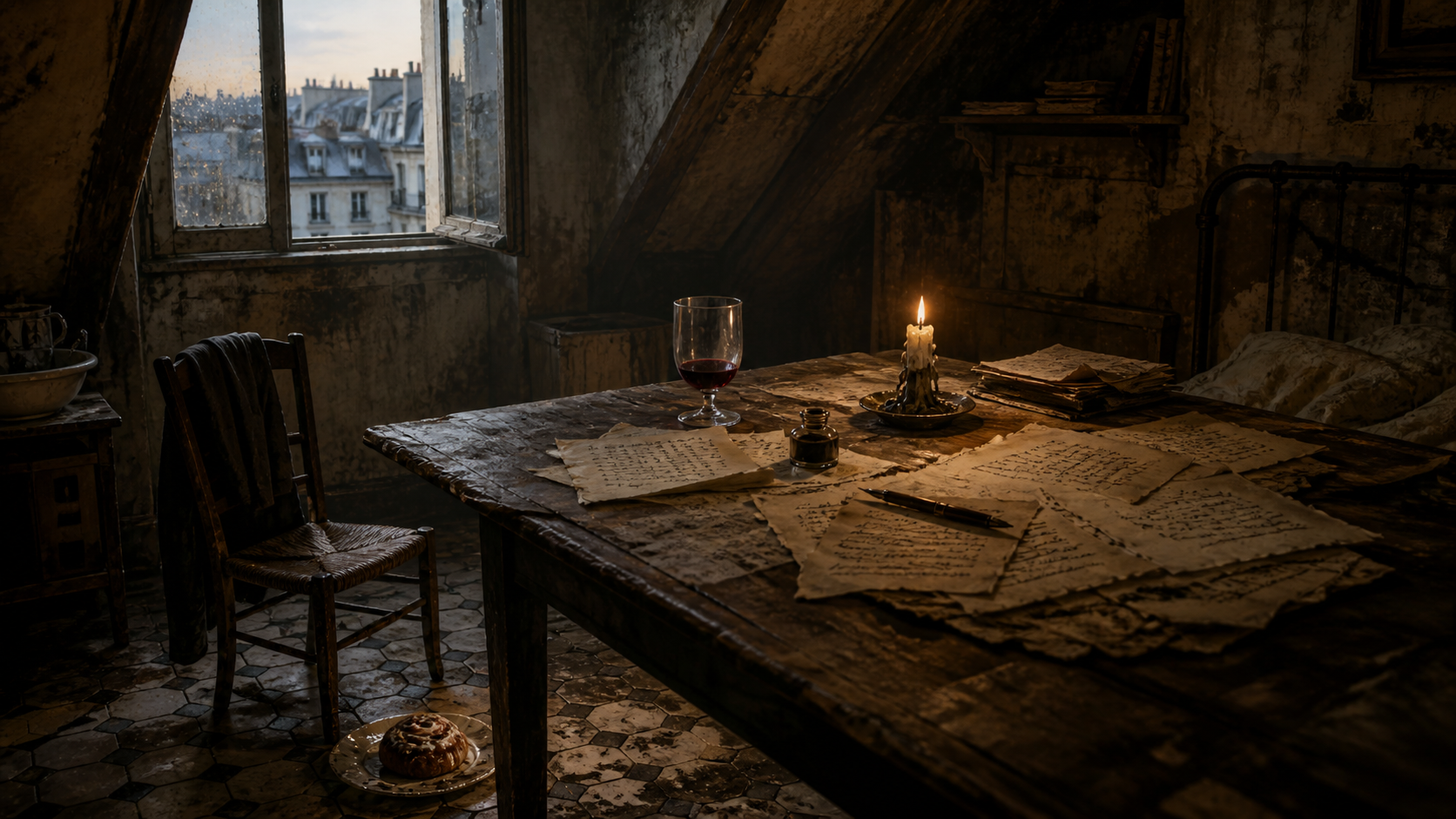
Henry Miller, alone in a dream, sips a glass of cheap Parisian wine while thinking about how hard he would masturbate if he didn’t have so many words to write before bedtime.
This was the first miracle:
that appetite, finding itself delayed, became literature.
The candle guttered in the room like a small guilty witness. The table leaned. The chair resented him. Paris pressed its damp mouth against the window and whispered the old filth: rent, hunger, thighs, revolution, unpaid tabs, God, plumbing. Somewhere in the walls, a pipe knocked with the moral insistence of a creditor.
Henry stared at the page.
The page stared back, smooth and obscene.
“One more paragraph,” he told his body.
His body, that ancient union of organs and bad intentions, convened immediately in emergency session. The loins rose in opposition. The stomach abstained. The liver, having received the wine, declared itself neutral but interested. The hand hovered above the page, unsure whether it belonged to civilization or the animal that had invented it.
Outside, the unfortunate were being taxed for the privilege of remaining unfortunate. Above them, the upper crust swept the creepy residue under the rug, where the fibers latched onto the mess with the dumb obedience of institutions. Every unknowing foot pressed it deeper. Every polished shoe helped consecrate the lie.
The official explanation was simple:
your enemy is your neighbor.
So neighbor turned on neighbor.
Small fights between small minds erupted the world over.
A man blamed the man beside him for the missing bread.
A woman blamed the woman below her for the cold.
Children learned the names of enemies before the names of trees.
And under the rug, the residue listened.
It learned patience.
It learned weight.
It learned the choreography of denial.
Henry dipped his pen.
The second miracle was this:
that the obscene can become diagnostic.
He wrote not because he was pure, but because he was crowded. Words stood in him like tenants in a condemned building. Desire hammered on the pipes. Memory spoiled in bowls. The milk of reason curled overnight, and from its skin rose unsanctioned worlds—small, breathing kingdoms born from the afterbirth of oversight.
No god had approved them.
No clerk had stamped them.
No parliament had debated the legitimacy of their weather.
And yet they formed: continents of curdled thought, villages of shame, republics of appetite, all drifting in the warm blind spot between what was forbidden and what no one remembered to forbid.
Henry drank.
The wine was cheap enough to be honest.
He thought of the cinnamon bun at the foot of the toilet. The bun that was not eaten, not gone, but becoming. The bun that had crossed from pastry into guilt, from guilt into fuel, from fuel into prophecy. The bun that knew all flesh is temporary architecture. The bun that whispered from the meatsack cathedral:
I was never contained. I was only delayed.
He thought of Mordor, of brisk walks, of iced tea baptisms, of Debussy’s third movement opening like a soft wound in the middle of time. He thought of the unnamed carpenter who was actually Voldemort. He thought of Horcruxes lodged in frosting. He thought of Henry Miller, which was to say, he thought of himself thinking of himself, which is where vanity and metaphysics begin sharing a bed.
The third miracle was this:
that language made a ladder out of filth and then blamed heaven for being reachable.
His body objected again.
“Later,” Henry said.
But later was a country with no reliable border. The hand could defect at any moment. The mind was a customs officer easily bribed. The candle bent low, trying to see what would happen next.
He wrote:
“The world is not ruined by monsters, but by the tidy men who explain where the smell is coming from.”
He liked that.
He hated that he liked it.
He wrote more.
“They call the stain heritage. They call the cracking floor a difference of opinion. They call the neighbor dangerous because the neighbor is close enough to touch, and the architect is not.”
The room shifted. The residue under the rug swelled slightly, pleased to be named.
This was the fourth miracle:
that naming a thing doesn’t kill it, but it does make it look up.
Henry’s loins quaked somewhere below the table, Parisian and doomed. But the words were arriving now—shabby, urgent, half-dressed—dragging their little suitcases across the floor of his skull. They had come too far to be turned away. They smelled of smoke, bread, cheap wine, poor decisions, and the dreadful human need to testify.
He wrote until the page stopped being blank and became complicit.
He wrote until the candle collapsed into its own wax.
He wrote until his body, defeated but not convinced, slumped back into the chair of itself.
At dawn, the inspectors arrived.
They wore clean collars and carried clipboards. They examined the rug. They sniffed the air. They stepped over the soft breathing place beneath the floorboards and declared the structure sound.
“No miracle here,” said the first.
“Only residue,” said the second.
“Possibly neighbor-related,” said the third.
Henry, pale and triumphant and slightly sticky with existence, lifted the pages from the table.
There it was in full:
The appetite deferred.
The filth transcribed.
The bun becoming.
The world misfiled.
The residue breathing.
The body denied just long enough for the sentence to survive.
And somewhere,
beneath Paris,
beneath bureaucracy,
beneath class,
beneath plumbing,
beneath the rug,
beneath even the tired old lie that anyone ever gets away clean—
something tender and unsanctioned opened one eye.
The miracle was complete.
Not because the body was conquered.
But because, for one ridiculous night,
the words finished first.