A Frenzy of Flesh and Divinity
The Sistine Chapel
I’ve visited the Sistine Chapel twice, though “visited” suggests a stillness the experience doesn’t really allow.
The room is crowded and restless. A low murmur gathers beneath the ceiling, grows into a steady volume swell, and is suddenly tamped out by security guards shouting for silence.
It works for a few seconds. Then the noise begins again.
Photography isn’t permitted, which doesn’t stop people from taking pictures. It only makes them take them quickly, covertly, and without much regard for what they’re capturing. A phone rises, points vaguely upward, steals some crooked fraction of the ceiling, then disappears into a pocket. The photograph will probably never be looked at. In the meantime, the person taking it has missed another few seconds of standing beneath the thing itself.
I don’t say this from outside the crowd. I was in it, craning my neck, being jostled along, trying to feel the enormity of what Michelangelo had accomplished while also being aware of the feet, voices, guards, phones, and general machinery of tourism surrounding me.
The room is overwhelming. Somehow, the weight of encountering one of humanity’s greatest achievements survives the machinery built to exploit our curiosity. It’s a sanctuary, but it’s also a funnel. It’s sacred, commercial, bureaucratic, beautiful, and exhausting. You enter hoping for revelation and find yourself trying not to step on someone’s heel.
I’ve spent far more time with the Sistine Chapel in books and reproductions than I was ever able to spend beneath it.
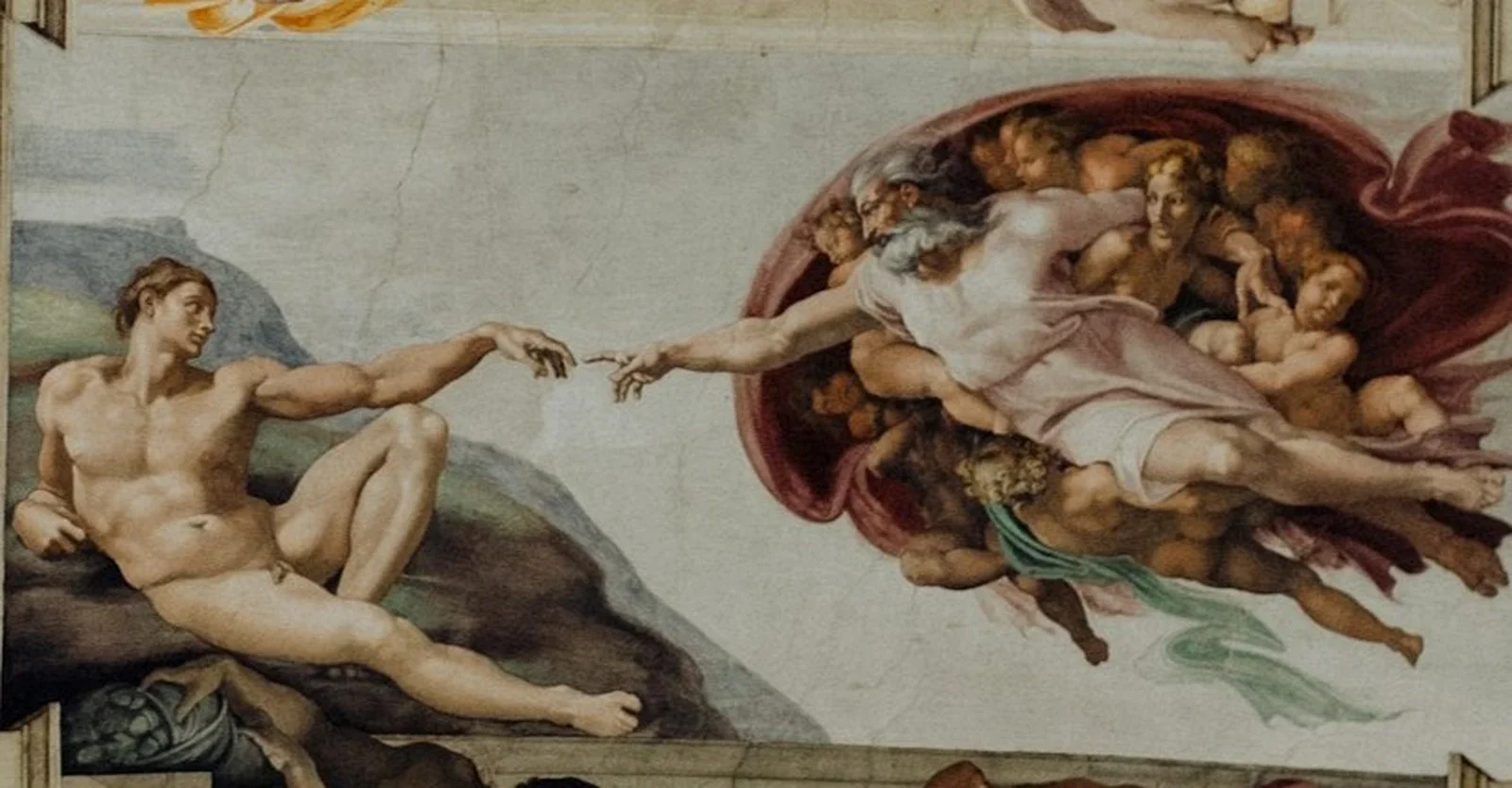
The image I keep returning to is Adam’s hand.
Adam’s Hand
The Creation of Adam is so familiar that it’s almost become invisible. We know the two fingers. We know the small gap between them. We know the image as shorthand for creation, inspiration, electricity, technology, and any number of things suddenly coming to life.
The gesture has been repeated so often that it can be difficult to see what’s actually happening in it.
The fingertips are only the punctuation. The sentence is written in the bodies.
God isn’t hovering serenely above Adam. He’s surging toward him. His body twists forward inside a crush of angels, fabric, limbs, and divine momentum. His arm is fully extended. His hand reaches across the final distance with something close to desperation.
Adam, meanwhile, is laid back.
He reclines against the earth with the magnificent indifference of someone being given exactly what he expected to receive. His arm rests against his knee. His wrist is slack. He raises his finger, but only just.
God lunges across eternity while Adam can barely be bothered to meet him halfway.
There’s a charitable reading of this. Adam hasn’t yet been fully animated. His body exists, but his will hasn’t arrived. He can’t reach any harder because the thing that would allow him to reach is still being given to him.
That makes sense.
But Michelangelo didn’t have to make him look so comfortable.
There’s no fear in Adam. No bewilderment. No gratitude. He doesn’t look overwhelmed by the fact of his own existence. God appears to be straining every muscle of the divine body to deliver life, while Adam receives it with the casual entitlement of a man accepting something that already belongs to him.
That imbalance of effort may be the real drama of the painting.
The fingers don’t touch. Michelangelo holds them apart, preserving the unbearable fraction of a second before creation is complete.
The entire fresco narrows to that gap.
It’s a tiny emptiness surrounded by enormous bodies. All the weight of heaven presses forward from one side. Adam’s beautiful, unfinished heaviness rests on the other. Between them is almost nothing, yet that almost nothing contains life, consciousness, freedom, separation, and the possibility of refusal.
It contains the human condition.
The Gift of Consciousness
The shape surrounding God has often been compared to a cross-section of the human brain. Once you see it, it’s difficult to unsee. The red fabric, the folds, the arrangement of the figures, and the projection beneath it all form something uncannily anatomical.
The interpretation is debated, as interpretations like this usually are. I’ve written before about the space between artistic intention and the meaning a viewer brings to a work, and this is exactly the kind of image where that space becomes interesting.
Michelangelo knew the human body from the inside. He studied cadavers. He dissected them. He understood the structures beneath the surface with a precision few artists before him could approach.
He would’ve known the shape of a brain.
That doesn’t prove the resemblance was intentional, but it makes accident feel less satisfying as an explanation.
If the shape is deliberate, God isn’t merely giving Adam life. He’s giving him mind.
Adam’s body already appears complete. It’s one of the great bodies in Western art: strong, proportioned, sensual, and fully formed. He isn’t a lump of clay waiting to become human. He’s physically perfect.
What he lacks is the thing that will allow him to know that he exists.
God reaches from inside the brain to awaken consciousness.
The gift isn’t simply animation. It’s intelligence, self-awareness, imagination, language, memory, moral freedom, and the ability to stand apart from creation long enough to contemplate it.
It’s the capacity to recognize the divine.
It’s also the capacity to feel entitled to it.
Consciousness allows us to experience existence as a miracle, but it also allows us to forget that it’s one. The mind can bow in wonder, or it can examine the world, name everything in it, and decide that naming something is the same as owning it.
Intelligence makes gratitude possible.
It also makes pride possible.
God gives Adam the very faculty by which Adam can turn away from God.
This is where creation, divinity, and damnation begin to occupy the same gesture.
The Fall hasn’t happened yet. There’s no serpent, no fruit, no expulsion from Eden. But the possibility of the Fall is already present in Adam’s raised hand. Freedom can’t be separated from the possibility that it’ll be misused. To create a conscious being is to create something capable of estrangement from its creator.
The gift contains the disaster.
God gives everything. Adam assumes he was supposed to get it.
Entitlement isn’t the same as refusal. It’s quieter than that. It’s the inability to experience a gift as a gift.
Adam isn’t pulling his hand away. He’s willing to receive life, consciousness, intelligence, and dominion. He just doesn’t seem astonished by any of it.
This may be the first truly human thing about him.
We inherit lives we didn’t design, inside bodies we didn’t build, surrounded by a world we didn’t make. We receive language, memory, music, touch, thought, desire, and the strange ability to know that someday we’ll lose them.
Then the impossible becomes ordinary.
Consciousness settles into habit. Existence becomes something we feel we’re owed. We wake into the world and begin complaining about the accommodations.
Standing in the Sistine Chapel, it’s difficult not to see the same impulse at work. We’re surrounded by an accomplishment so enormous that it should probably flatten us. I’ve felt a version of that before with Guernica, another work whose scale requires unhurried encounters.
Michelangelo spent nearly four years standing on scaffolding with his neck bent backward at a punishing angle, covering a vast ceiling with bodies that seem to contain the whole weight of creation.
And beneath it, we raise our phones for two seconds and take a crooked picture we’ll never look at again.
That isn’t meant as a scolding. I understand the impulse. We want proof that we were there. We want to take something away with us. We want to hold onto the experience before it vanishes.
But the attempt to possess it can prevent us from receiving it.
Maybe that’s what Adam’s hand has always been about.
Theology Becomes Posture
Michelangelo understood how to make a body carry an argument. His figures don’t merely occupy space. They bear metaphysical pressure. Their shoulders, backs, thighs, and torsos are massive because the ideas inside them are massive.
The weight of the human condition mirrors the weight of their frames.
Nothing is purely spiritual. Nothing remains abstract.
Creation has to travel through an arm.
Divinity has to pass through a wrist.
The soul has to cross a fraction of empty air between two fingers.
This is the frenzy of flesh and divinity at the center of Michelangelo’s work. The sacred doesn’t hover politely above the body. It fights its way through muscle, tendon, weight, exhaustion, and touch.
The body isn’t an obstacle to the divine.
It’s where the divine becomes visible.
God’s urgency is physical. Adam’s indifference is physical. Theology becomes posture.
That may be Michelangelo’s genius. He doesn’t explain the human condition. He gives it shoulders. He gives it a spine. He places it under the strain of its own enormous weight and asks it to reach.
All the force of creation is directed toward Adam, but the final distance can’t be crossed by God alone.
Adam has to move his finger.
He barely does.
Perhaps that’s the mercy of the image. For all his indifference, Adam’s hand isn’t entirely still. However casually, however weakly, he does reach.
God offers everything.
Adam offers almost nothing.
It may be enough.
Or perhaps that’s the most damning observation of all: that the divine gives everything, asks almost nothing in return, and even that almost nothing seems to exhaust us.